Beyond AI Coding: Building Autonomous Agent Ecosystems
For experienced engineers ready to build agents, not just use them: architecture, tool calling, MCP, memory, orchestration, evaluation and security, with the failure modes that matter.
Part 4 of the series The AI Revolution: What Actually Changed for Software Developers.
Most developers in 2026 use agents. A much smaller group builds them.
That gap is the opportunity. In the 2026 Stack Overflow survey, coding agents are the top AI use case, but AI memory and agent orchestration tools show a clear gap between current adoption and stated interest. People want these systems. Few know how to build them well.
This guide is for engineers who want to be in that group: building agents that connect tools, automate workflows and run with real autonomy, safely.
What an agent actually is
Strip away the marketing and an agent is a loop:
- A model receives a goal and context.
- It decides on an action, usually a tool call.
- Your code executes the tool and returns the result.
- The model reads the result and decides the next step.
- It stops when the goal is met, a limit is hit, or a human is needed.
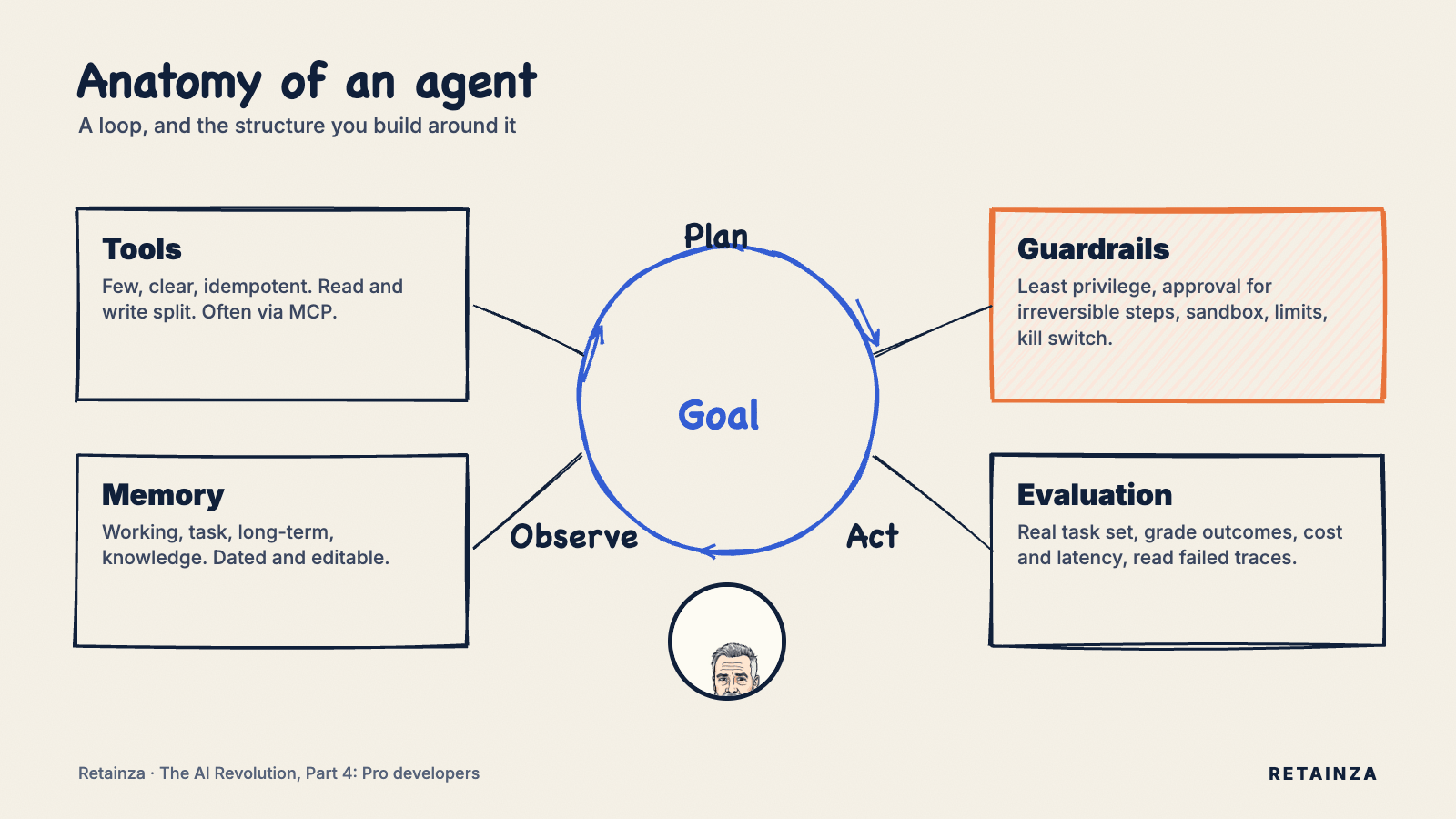
Everything else, from memory and multi-agent setups to planners, is structure around that loop. Getting the loop right matters more than any framework.
The building blocks
Tools: the agent's hands
Tool design is where most agent quality is won or lost.
- Few, clear tools beat many vague ones. Name them like an API you'd be proud of. Describe when not to use them.
- Return useful errors. "Customer not found; did you mean id cus_123?" lets the model recover. A stack trace doesn't.
- Make tools idempotent where you can, so retries don't double-charge or double-send.
- Separate read tools from write tools. It makes permissions and review much simpler.
- Keep outputs small. Paginate, summarise, return IDs. Context is a budget.
MCP: a standard way to plug in tools
The Model Context Protocol, introduced by Anthropic in late 2024 and now supported across many clients and agents, is an open standard for exposing tools, data and prompts to AI applications. Instead of writing a custom integration for every agent, you write one MCP server and any MCP-capable client can use it.
Practical advice:
- Wrap your internal systems (docs, tickets, deploy status, metrics) as MCP servers with read-only tools first.
- Treat each server as a security boundary: least privilege, scoped tokens, audit logs.
- Treat tool output as untrusted input. A document or web page the tool returns can contain instructions aimed at the model.
Memory: what the agent knows across steps and sessions
- Working memory: the current conversation and recent tool results. Lives in the context window.
- Task memory: the state of a long job, such as plan, progress and decisions. A file, a scratchpad or a database row.
- Long-term memory: facts and preferences that persist across sessions. A store the agent reads and writes.
- Knowledge: your docs, code and data. Retrieval, search or MCP resources.
The hard parts are not storage. They're what to remember, when to forget, and how to stop stale or poisoned memories from steering the agent. Version memories, date them, and let humans see and edit them.
Orchestration: one agent or many?
Start with one agent and good tools. Move to multiple agents only when you have a real reason:
- Parallelism: independent research or independent code areas.
- Context isolation: a sub-agent reads 200 files and returns a two-paragraph conclusion.
- Separation of duties: one agent writes, another reviews, with different permissions.
Multi-agent systems multiply cost, latency and failure modes. Each hand-off loses context. Use them like microservices: when the boundaries are clear, not because they're fashionable.
The 2026 survey shows the tooling people reach for here: LangChain (30%) and the OpenAI Agents SDK (24%) for orchestration, and Make (39%) and n8n (33%) for workflow automation. Frameworks help, but understand the loop underneath so you can debug it.
Evaluation: the part everyone skips
You can't improve an agent you can't measure. "It worked when I tried it" is a demo, not an evaluation.
- Build an eval set early: 30–100 real tasks with known good outcomes, including nasty edge cases.
- Grade outcomes, not transcripts. Did the ticket get resolved, the test pass, the right record change?
- Track cost and latency per task, not just success rate.
- Run evals on every prompt, tool or model change. Treat prompts like code: versioned, reviewed, tested.
- Read failed traces. Most agent bugs are visible in the first wrong tool call.
Remember the developer research: METR found experienced developers felt 20% faster while measuring 19% slower in early 2025 (METR). Feelings about AI systems are unreliable. Measure.
Security: autonomy needs boundaries
The more an agent can do, the more an attacker can make it do.
- Prompt injection is the main threat. Any text the agent reads (emails, web pages, tickets, tool output) can try to give it orders. Never let untrusted content authorise actions.
- Least privilege. Scoped, short-lived credentials per tool. No shared admin keys.
- Human approval for irreversible actions: payments, deletes, deploys, sending messages to customers.
- Sandbox execution. Run code and shell tools in isolated environments with no access to production secrets.
- Limits everywhere: max steps, max spend, rate limits, timeouts.
- Audit logs of every tool call, input and output. You'll need them the first time something goes wrong.
- Kill switch. One flag that stops all agents.
A practical path from user to builder
- Automate one annoying workflow you own. Release notes, triage of a support inbox, a weekly metrics summary.
- Build one MCP server for an internal system, read-only.
- Write an eval set of 30 tasks for it and measure.
- Add one write action behind human approval.
- Add memory only when you can say exactly what it should remember.
- Ship to your team, watch the traces, iterate.
That's how you go from "I use Claude Code" to "I build the agents my team runs on."
The bigger picture
The people building AI talk about far more than code. Demis Hassabis describes AI, for the next decade or so, as a tool to help scientists make discoveries (Dædalus, 2026). Jensen Huang talks about closing the technology divide so that everyone can instruct a computer (Milken Institute, 2025).
Agent builders are the people who turn those ideas into working systems. That's a responsibility: the systems you build will act on behalf of people who can't read your code. Build them to be measurable, bounded and honest about what they can't do.
Start building your own agents. Connect tools. Automate whole workflows. And measure everything.
Where to go next
- Back to the hub: What actually changed for developers, 2023–2026
- Previous level: The senior developer in the agent era
Sources
- Stack Overflow Developer Survey 2026, AI: survey.stackoverflow.co/2026/ai
- Model Context Protocol: modelcontextprotocol.io
- Anthropic: AI's impact on software development (2025)
- METR: Early-2025 AI and experienced open-source developer productivity (2025) and 2026 update
- Dædalus: A Conversation with Demis Hassabis (2026)
- Milken Institute: Conversation with Jensen Huang (2025)