The Senior Developer in the Agent Era: From Coding to Orchestrating
When agents can write the code, senior work moves up: architecture, task design, delegation, review at scale and accountability. A guide for senior engineers in 2026.
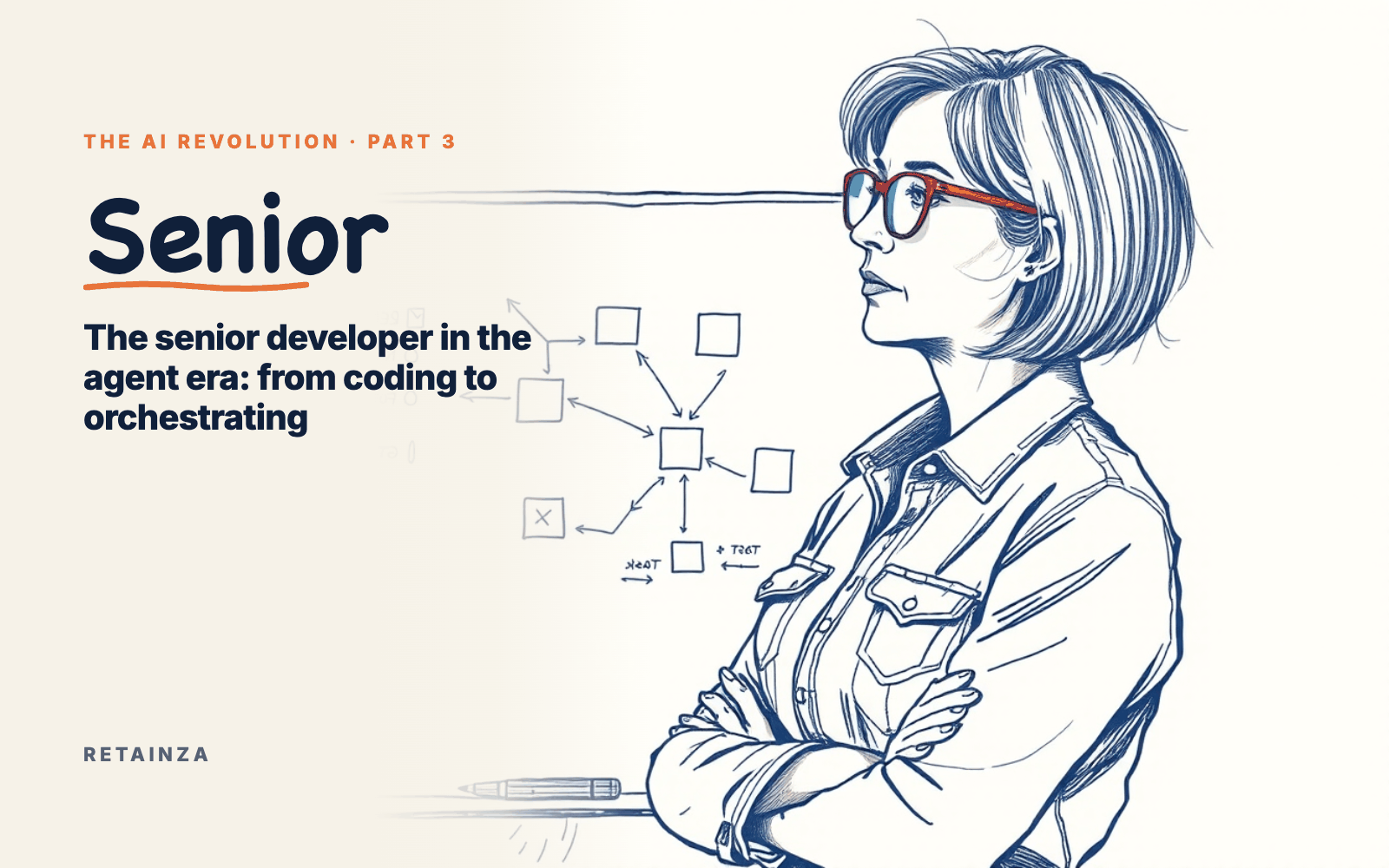
Part 3 of the series The AI Revolution: What Actually Changed for Software Developers.
For most of your career, being senior meant two things: you could write the hard code, and you could tell when other people's code was wrong.
In 2026 the first part matters less every quarter. The second part matters more than ever, and a third part has appeared: deciding what work an agent should do, how it should do it, and how you'll know it did it right.
That's orchestration. It's the senior skill of the agent era.
The experienced-developer paradox
The most important study for senior engineers isn't the one that says AI makes you faster. It's the one that says it can make you slower.
In early 2025, METR ran a randomized trial with 16 experienced developers working on large, mature open-source repositories they knew well. With AI tools, tasks took 19% longer. The developers believed AI had sped them up by about 20% (METR, 2025).
METR's February 2026 follow-up suggests tools have improved, with estimates pointing toward a speedup, but METR calls that signal unreliable. One reason is telling: many developers refused to work without AI at all, and 30–50% held back tasks they didn't want to do without it.
What should a senior engineer take from this?
- Your feeling of speed is not data. Measure cycle time, rework and incidents, not how productive the session felt.
- Context is your edge, and the agent's weakness. In a mature codebase, the hard part is the unwritten knowledge: why that odd retry exists, which customer depends on that field. Agents don't have it unless you give it to them.
- Tools moved fast. The setting of that study (early 2025, mostly chat-plus-editor workflows) is not today's agent-heavy setting. Re-check your assumptions every few months.
From writing to directing
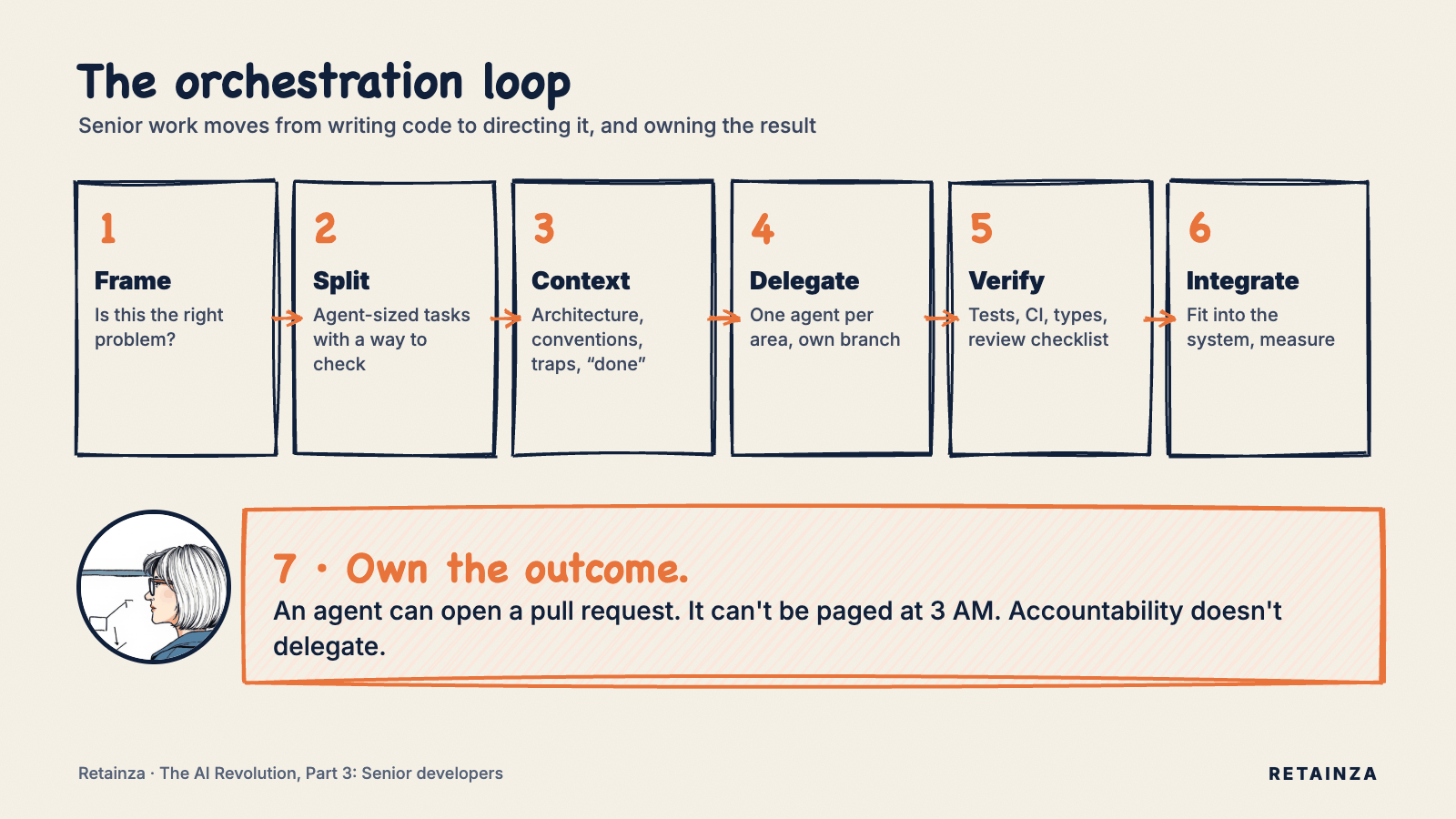
1. Frame the problem
Agents are very good at solving the problem they're given. They're bad at noticing it's the wrong problem. Your first job is the one AI can't do: decide what's worth building, and what's not.
2. Split the work into agent-sized tasks
A good agent task has a clear goal, a small blast radius and a way to check it. "Improve performance" is not a task. "Cut p95 latency of /search below 300 ms without changing the response shape; benchmark included" is.
Good to delegate:
- Well-specified features with tests
- Migrations with a clear pattern
- Test coverage for existing behaviour
- Refactors with a mechanical rule
- Docs, changelogs and runbook drafts
Keep for humans (or pair closely):
- Data model and API contract decisions
- Security boundaries and auth design
- Trade-offs that affect customers or cost
- Incident response and production changes
- Anything you can't verify cheaply
The 2026 Stack Overflow survey reflects this instinct: developers lean on AI for implementation and debugging, but only about 20% use it for deploying, operating or troubleshooting production systems.
3. Give context like a design doc
Write down what you'd tell a new senior hire: the architecture, the conventions, the traps, the definition of done. Keep it in the repository (an AGENTS.md, CLAUDE.md or similar file that agents read) so every agent run starts with it. This is the highest-leverage writing you'll do this year.
4. Delegate in parallel, carefully
Running several agents at once is real now. METR even noted its time tracking breaks down for developers running multiple agents concurrently. Rules that keep it sane:
- One agent per area of the code. Two writers on the same files means conflicts and silent overwrites.
- Each task in its own branch or worktree.
- Each task ends in a reviewable artifact: a PR, a report, a test run.
5. Verify at scale
When agents can produce ten PRs before lunch, review becomes the bottleneck. Invest in what makes review cheap:
- Strong tests and CI that fail loudly. These are now your main defence.
- Type systems, linters, contract tests as guardrails agents can't argue with.
- Small PRs by policy. Ask agents for small, stacked changes.
- A review checklist for AI changes (intent, edges, invented APIs, security, scope). Teach it to your juniors; see the junior guide.
- Second-opinion review. Use a separate agent to review a change, then review the review.
6. Own the outcome
An agent can open a pull request. It can't be paged, apologise to a customer, or explain to leadership why a trade-off was right. Accountability doesn't delegate. The more you delegate the typing, the more of your job is judgment and responsibility.
Architecture matters more, not less
Fast code generation amplifies whatever architecture you have. A clean architecture with clear boundaries lets agents work safely in parallel. A tangled one lets them make a bigger mess, faster.
Senior engineers should push for:
- Clear module boundaries and contracts, so agent work stays local.
- Boring, documented patterns, so generated code matches them.
- Observability built in, so you can see what AI-written code actually does in production.
- Deletion. Code is cheap to write now, so the cost is in maintaining it. Be the person who asks what can be removed.
Growing the people below you
A real risk of the agent era: juniors who ship a lot and learn little. You can prevent that.
- Give juniors tasks that teach, and ask them to explain their AI-assisted changes in review.
- Review their reasoning, not only their diffs.
- Pair on debugging. It's where judgment transfers.
- Share your context documents. They're the onboarding guide for humans and agents alike.
Measure what matters
If your team adopted agents, track:
- Lead time from ticket to production, not lines written.
- Change failure rate and rework. Are AI-heavy PRs reverted more?
- Review time. Is review now the bottleneck?
- Incidents traced to unverified changes.
If those improve, AI is helping. If only output volume improves, you're generating work, not value.
Stop thinking only about code. Start thinking about architecture, delegation and orchestration.
Where to go next
- Back to the hub: What actually changed for developers, 2023–2026
- Previous level: The new junior developer skillset
- Next level: Beyond AI coding: building autonomous agent ecosystems
Sources
- METR: Early-2025 AI and experienced open-source developer productivity (2025) and 2026 update
- Stack Overflow Developer Survey 2026, AI: survey.stackoverflow.co/2026/ai
- Anthropic: AI's impact on software development (2025)
- OpenAI: Jobs in the Intelligence Age (2025)