The AI Revolution: What Actually Changed for Software Developers Between 2023 and 2026?
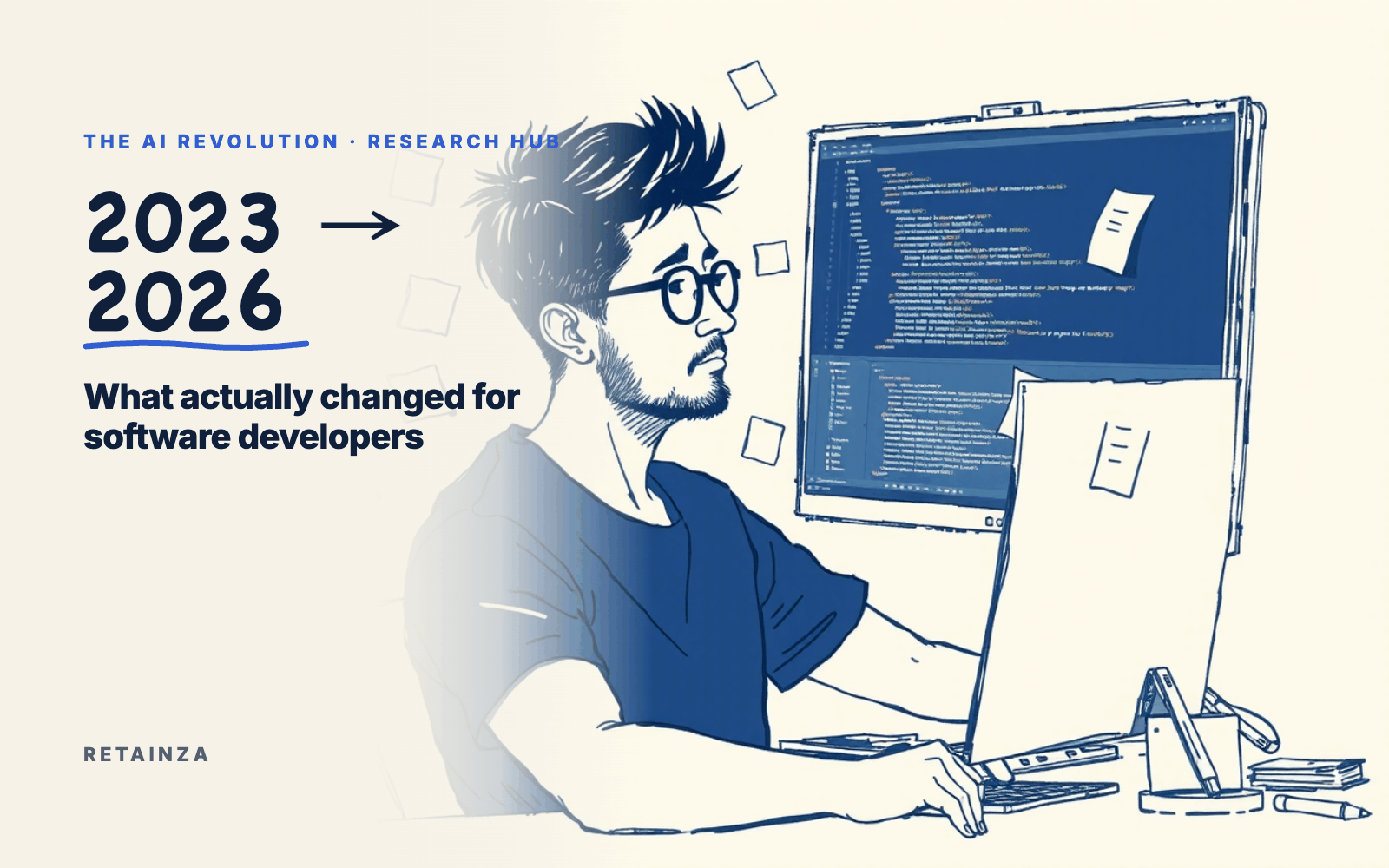
Four years, five studies and two surveys of 80,000 developers. What AI really changed in software work, what it didn't, and why the next skill is judgment, not typing.
In 2023 the question was simple: can AI help me write code faster?
In 2026 nearly every developer has an answer to that one. The harder question is the one almost nobody asks out loud: if AI can write a lot of the code, what exactly is my job now?
This is the research hub for a five-part series. It covers what changed between 2023 and 2026, what the evidence really says (it is messier than social media suggests), and then points you to the guide written for your level: intern, junior, senior or pro.
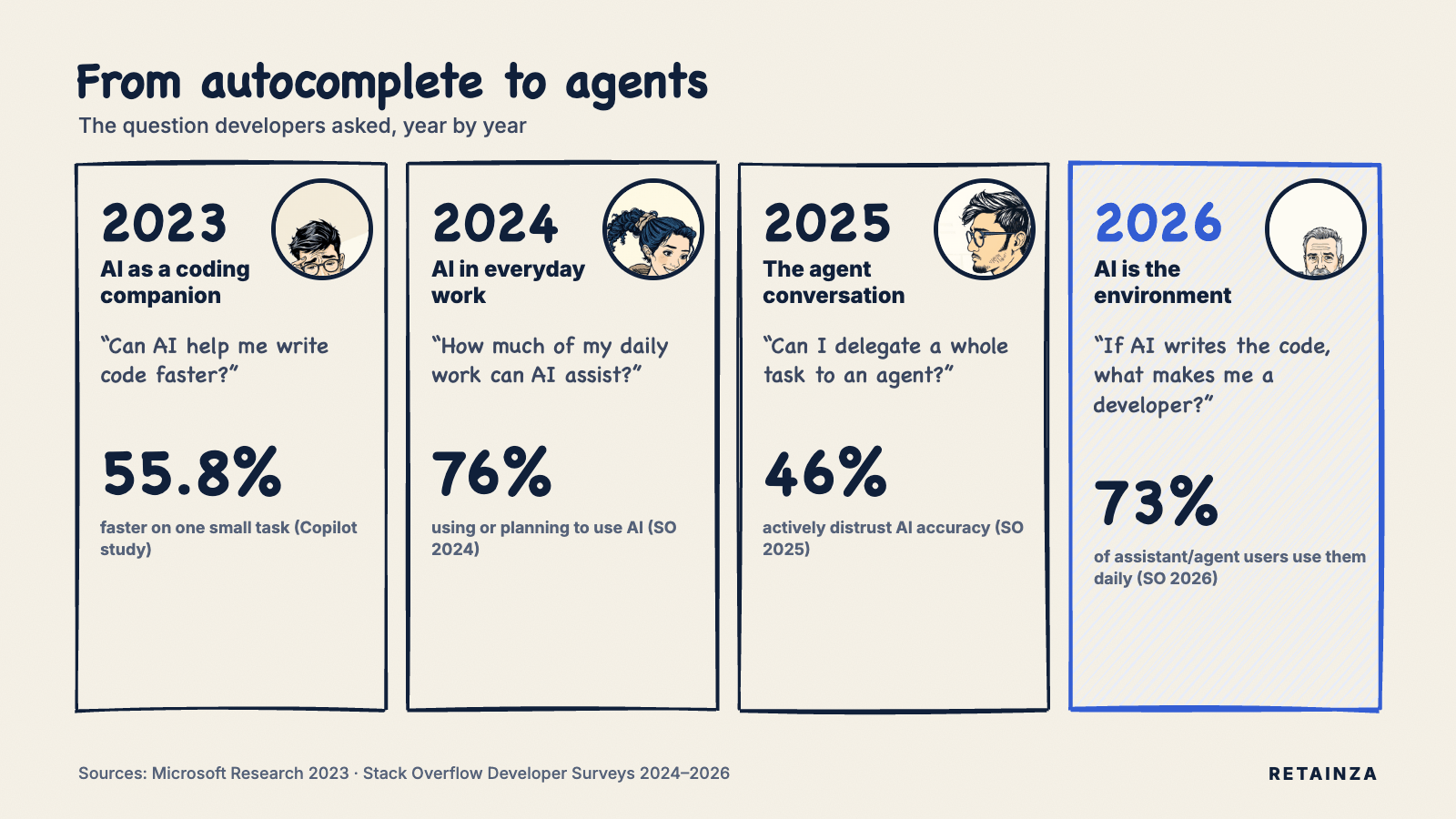
The timeline: four years, four questions
2023: AI became a coding companion
GitHub Copilot and ChatGPT put code suggestions and explanations in front of millions of developers. In Stack Overflow's 2023 survey, about 70% of respondents were using or planning to use AI tools.
The defining study of that year came from Microsoft Research and GitHub. Developers asked to build an HTTP server in JavaScript finished 55.8% faster with Copilot than without it (Peng et al., 2023). It was one well-scoped task, written from scratch. Keep that detail in mind.
The question: Can AI help me write code faster?
2024: AI entered everyday work
AI moved from "try it" to "use it daily": debugging, docs, refactoring, learning a new framework. Stack Overflow's survey put usage-or-planning at 76%. Anthropic introduced the Model Context Protocol (MCP) in November 2024, an open standard for connecting AI models to tools and data. It looked like plumbing at the time. It turned out to matter a lot.
The question: How much of my daily work can AI assist with?
2025: the agent conversation took off
Tools stopped only suggesting and started doing: reading a repository, running commands, editing several files, running tests. Anthropic's analysis of 500,000 coding conversations found that 79% of Claude Code conversations were "automation" (the AI doing the task) compared with 49% on the regular Claude.ai chat (Anthropic Economic Index, April 2025). Startups led adoption; enterprises lagged.
At the same time, trust went the other way. In the 2025 Stack Overflow survey (49,000+ respondents), 84% were using or planning to use AI, yet 46% actively distrusted the accuracy of AI output, against 33% who trusted it. Only about 3% trusted it highly. The top frustration, named by roughly two thirds of respondents: AI solutions that are almost right, but not quite.
The question: Can I delegate an entire engineering task to an agent?
2026: AI is part of the environment
The 2026 Stack Overflow survey (30,000+ respondents, published October 2026) shows how far it has gone:
- Coding assistants and agents are now the number one AI use case (66%), ahead of general chatbots (63%).
- 73% of people who use AI coding assistants or agents use them daily, and about a third of daily users spend four hours or more a day with them.
- The most used coding agents are Claude Code (66%) and GitHub Copilot (59%).
And yet:
- The most common trust answer is "I trust it when I can easily verify the output" (48%).
- About 6 in 10 respondents name a reason they avoid AI in some work. The top worry among them: losing their own skills.
- Only around 20% use AI for deploying, operating or troubleshooting production systems.
The question: If AI writes much of the code, what makes me a developer?
The contradiction: faster at typing, not always faster at shipping
Here is the result that surprised the industry.
In early 2025, the research group METR ran a randomized trial with 16 experienced open-source developers on 246 real issues in large, mature repositories they knew well. With AI tools allowed, tasks took 19% longer (METR, July 2025).
The most uncomfortable part was not the slowdown. Before the study, developers expected AI to make them 24% faster. After the study, they still believed it had made them about 20% faster. They felt faster while being slower.
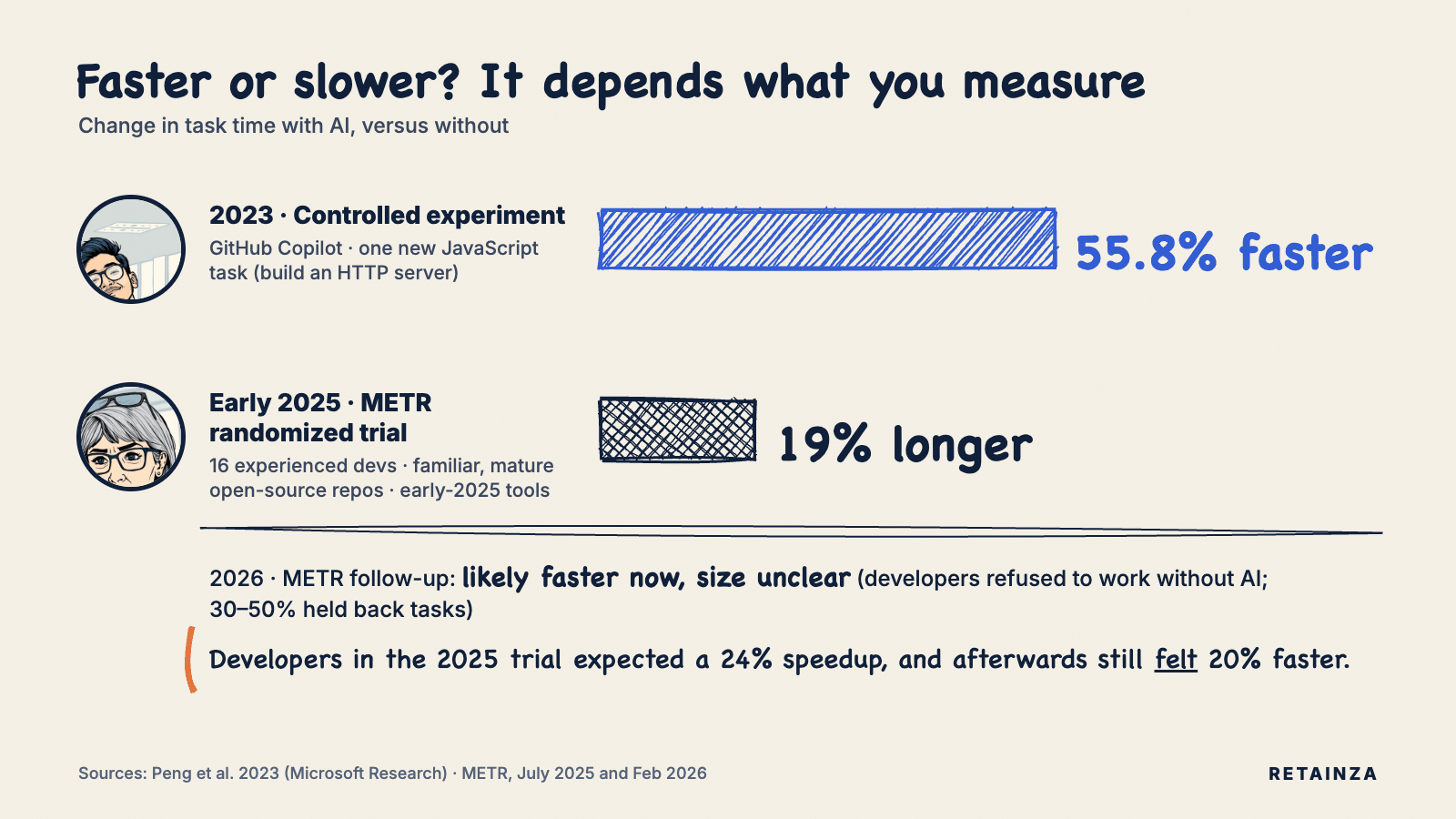
Now the honest update, because this number gets quoted without it. In February 2026 METR published a follow-up with 57 developers and 800+ tasks. Its estimates pointed toward a speedup this time (around 18% for returning developers, around 4% for new ones), but METR itself calls the signal unreliable: many developers refused to take part because they no longer wanted to work without AI, and 30–50% said they held back tasks they didn't want to do without it. METR's view is that developers are probably faster now than in early 2025, with only weak evidence for how much.
So which is it, 55.8% faster or 19% slower? Neither, as a general rule. These studies tested different things:
- Copilot experiment (2023): one new, small, well-defined task. Result: 55.8% faster.
- METR trial (early 2025): familiar, large, mature codebases. Result: 19% slower.
- METR follow-up (2026): mixed, agent-heavy work. Result: likely faster, size unclear.
What they agree on is the lesson of this whole series:
Generating code faster and finishing engineering work faster are not the same thing.
Code is the cheap part now. Understanding the requirement, checking the result, fitting it into the system and owning what ships are the expensive parts. That work did not go away. It moved to the front.
What the people building AI say it's for
The public conversation is mostly about tools: which editor, which model, which agent. The people building AI talk about something bigger.
Jensen Huang (NVIDIA) frames AI as a new computing platform that closes the "technology divide": only about 30 million people can program computers the traditional way, but nearly everyone can instruct an AI in their own language. He also gave the line most developers have heard: you won't lose your job to an AI, "you're going to lose your job to somebody who uses AI" (Milken Institute, May 2025).
Sam Altman (OpenAI) expects far more people to create software, while noting that "experts will probably still be much better than novices" if they embrace the new tools (OpenAI, Jobs in the Intelligence Age, 2025). The same paper argues that the world wants much more software, not less.
Demis Hassabis (Google DeepMind) sees AI, for the next decade or so, as a tool to help scientists: faster discovery in biology, materials and medicine, with the hypotheses still coming from human experts (Dædalus, 2026).
And it is worth going back further. The 1955 Dartmouth proposal that named the field started from the conjecture that "every aspect of learning or any other feature of intelligence" could be described well enough for a machine to simulate it (McCarthy, Minsky, Rochester and Shannon). Its research topics were language, neural networks, self-improvement, abstraction, and randomness and creativity.
None of that makes code completion unimportant. It is useful, and it pays the bills. But it is worth asking: AI was imagined as a way to explore intelligence itself. Are we only using it to finish our lines?
Assistant or agent: the difference that matters
A lot of confusion comes from treating these as the same thing.
An AI assistant suggests, explains and answers. You act. Its scope is a line, a function or a question. The main risk is a wrong suggestion you accept. Your core skill: asking well and reading carefully.
An AI agent plans and carries out multi-step tasks. It acts and you supervise. Its scope is a ticket, a refactor or a test suite. The main risk is a wrong change you don't notice. Your core skill: scoping, reviewing, verifying and owning the result.
The shift from assistant to agent is the shift from writing to directing. That is the real change of 2023–2026.
What hasn't changed: responsibility
Every study and survey above points to the same thing that did not move: someone still has to be accountable for what ships. An agent can open a pull request. It cannot be paged at 3 AM, explain a trade-off to a customer, or decide that a feature shouldn't be built.
The 2026 survey numbers say developers already know this. They trust AI most where they can check it, they want source attribution, and their biggest worry is losing their own skills. That is not fear of AI. It is a healthy instinct about where value is moving.
So, what's your next move?
The AI revolution is not the same revolution at every level. An intern and a staff engineer face completely different risks and opportunities. Pick your guide:
- Intern: Will AI make learning to code easier, or make beginners dependent on it? Learn to think with AI, not let it think for you.
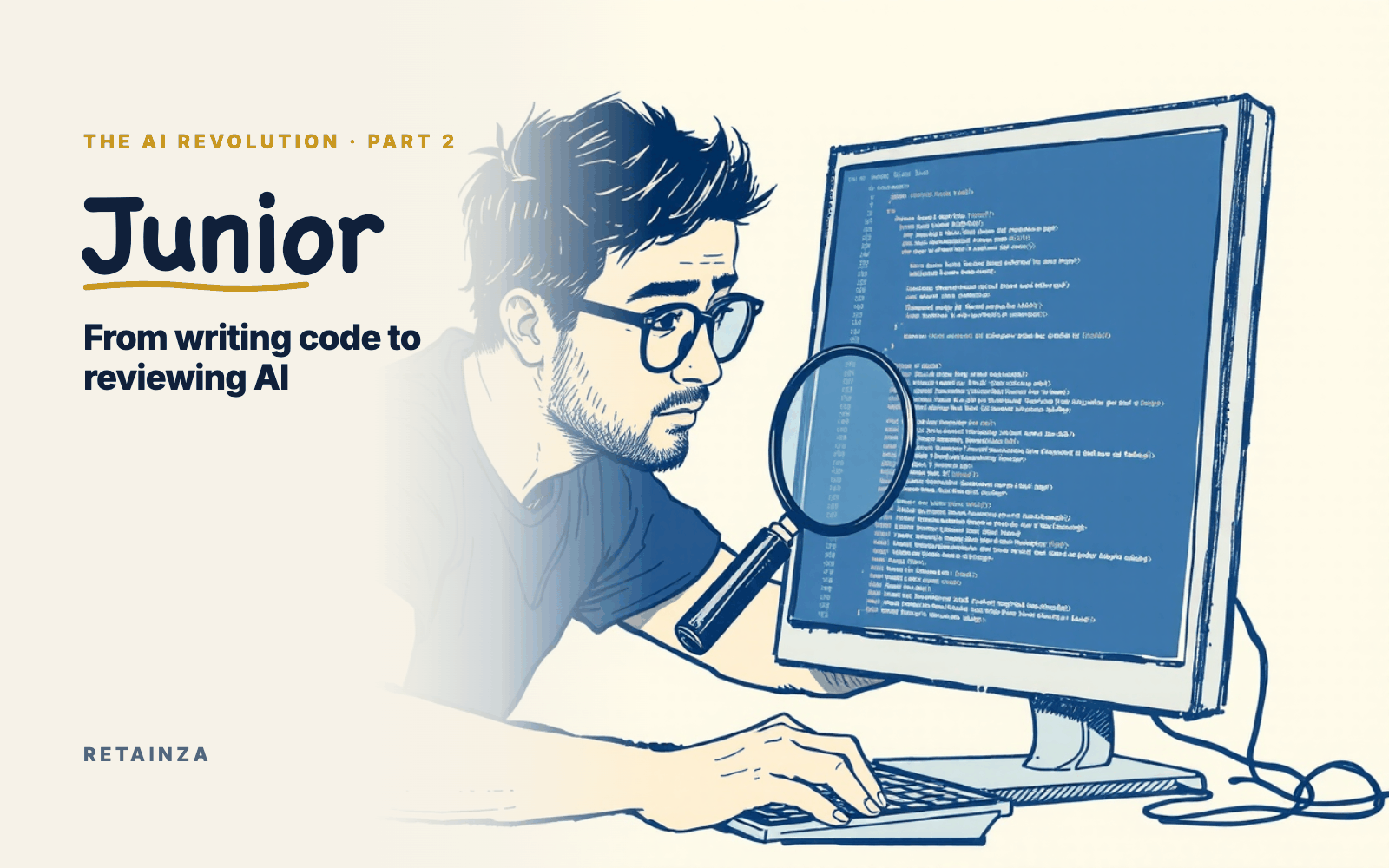
- Junior: From writing code to reviewing AI: the new junior developer skillset. Build, debug and verify with coding agents.
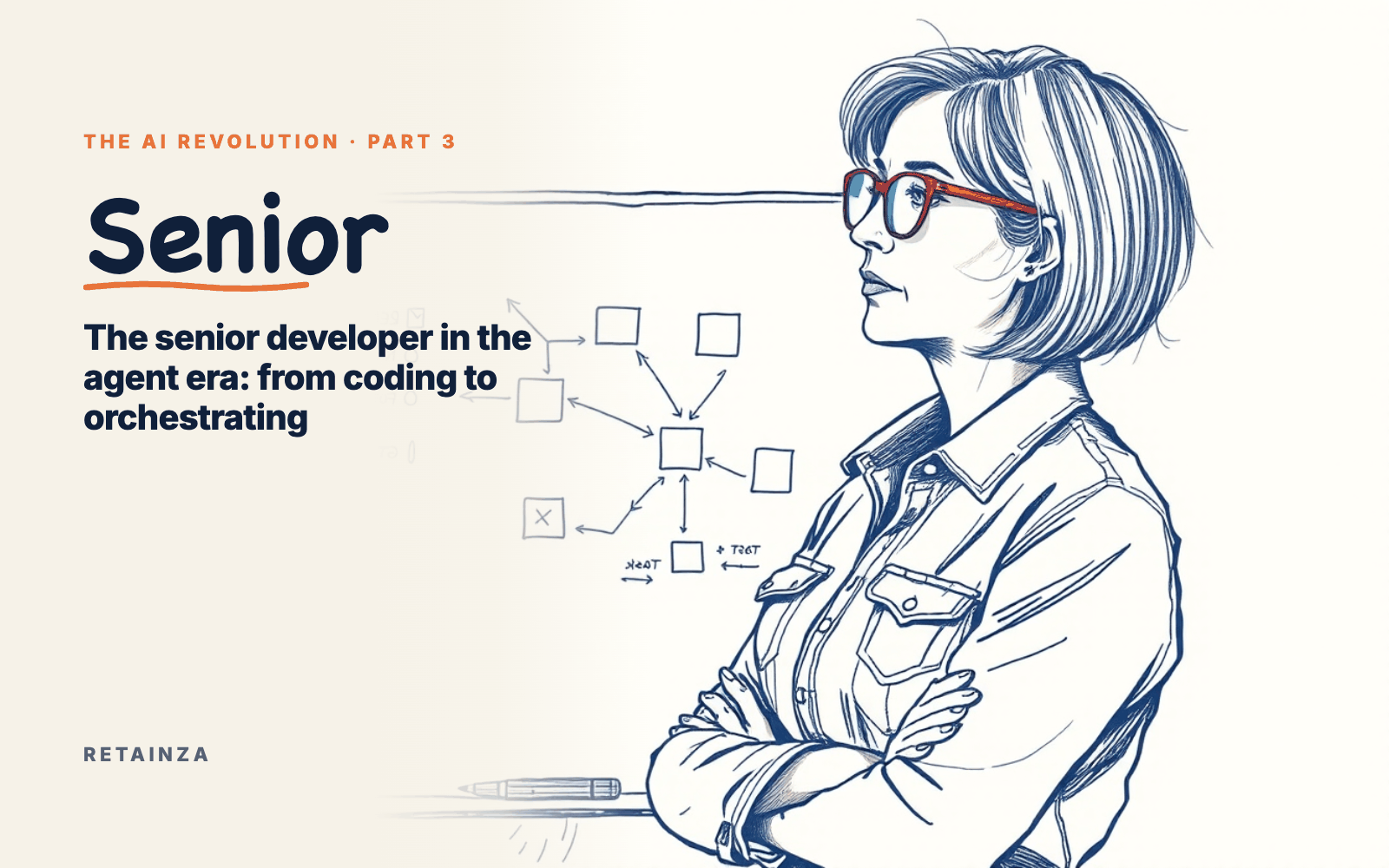
- Senior: The senior developer in the agent era: from coding to orchestrating. Architecture, delegation and accountability.
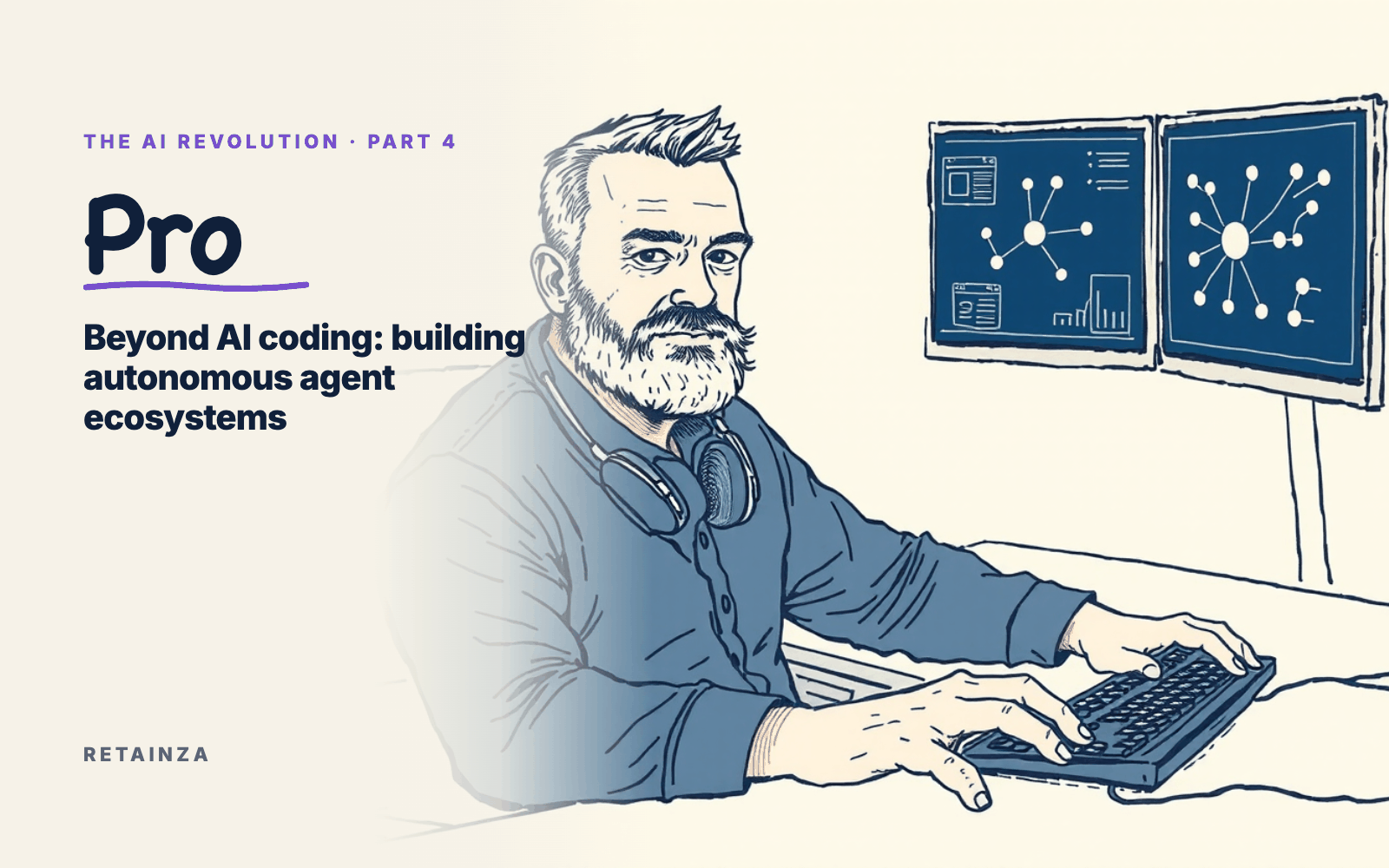
- Pro: Beyond AI coding: building autonomous agent ecosystems. Agents, MCP, tools, memory, evaluation and security.
Don't just use AI. Understand it.
Sources
- Stack Overflow Developer Survey 2025, AI section: survey.stackoverflow.co/2025/ai
- Stack Overflow Developer Survey 2026, AI section: survey.stackoverflow.co/2026/ai and results announcement
- Peng, Kalliamvakou, Cihon, Demirer: The Impact of AI on Developer Productivity: Evidence from GitHub Copilot (2023)
- METR: Measuring the Impact of Early-2025 AI on Experienced Open-Source Developer Productivity (2025) and We are Changing our Developer Productivity Experiment Design (2026)
- Anthropic: Anthropic Economic Index: AI's impact on software development (2025)
- OpenAI: Jobs in the Intelligence Age (2025)
- Milken Institute: Conversation with NVIDIA CEO Jensen Huang (2025)
- Dædalus: AI as the Ultimate Tool for Science: A Conversation with Demis Hassabis (2026)
- McCarthy, Minsky, Rochester, Shannon: A Proposal for the Dartmouth Summer Research Project on Artificial Intelligence (1955)