From Writing Code to Reviewing AI: The New Junior Developer Skillset
Junior developers now spend as much time checking code as writing it. How to build, debug and verify with coding agents, and grow faster because of it.
Part 2 of the series The AI Revolution: What Actually Changed for Software Developers.
The old junior developer job was mostly writing: take a well-scoped ticket, write the code, get it reviewed, learn from the comments.
The 2026 junior job is increasingly checking. An agent can draft the code in minutes. What your team needs from you is someone who can tell whether that code is right, make it right, and prove it.
That's not a smaller job. It's a different one, and if you lean into it, you'll grow faster than any junior developer before you.
What the numbers say about your day
- Coding assistants and agents are now the top AI use case (66%) in the 2026 Stack Overflow survey. Among people who use them, 73% use them daily.
- The most common tasks people hand to AI are generating code in a familiar area (about 69%) and debugging or refactoring (about 64%).
- The most used agents are Claude Code (66%) and GitHub Copilot (59%).
- And the trust answer that tops the chart: "I trust it when I can easily verify the output" (48%).
Read those together. AI produces a lot of the code. Humans trust it only as far as they can verify it. Verification is the job.
The 2025 survey named the cost: the top frustration was AI output that is "almost right, but not quite", and many developers found debugging AI-generated code took longer than expected. An "almost right" change that passes a quick glance is more dangerous than an obviously broken one.
The new core skill: reviewing code you didn't write
Reviewing AI code is different from reviewing a teammate's code. A teammate makes human mistakes. AI makes confident, fluent mistakes: code that reads well, follows conventions, and does the wrong thing.
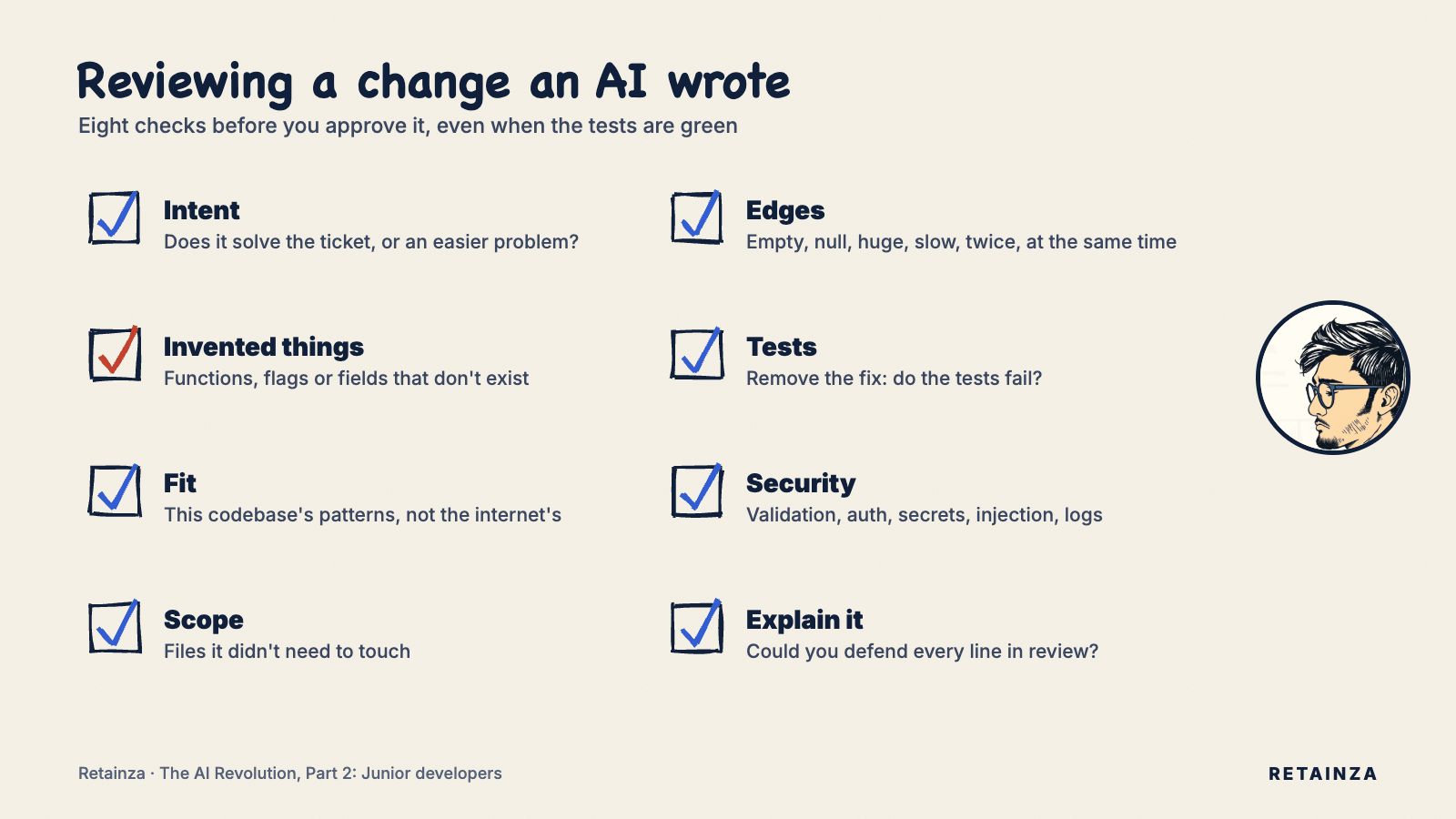
Checklist for every AI-written change:
- Intent. Does it solve the problem in the ticket, or a slightly different, easier problem?
- Edges. Empty input, null, very large values, timeouts, concurrent requests, a second click.
- Invented things. Functions, config keys, flags or API fields that don't actually exist.
- Tests. Do the tests check behaviour, or were they written to pass? Delete the fix: do the tests fail?
- Fit. Does it follow the patterns of this codebase, or generic patterns from the internet?
- Security. Input validation, auth checks, secrets, SQL built from strings, data in logs.
- Scope. Did it touch files it didn't need to? Big diffs hide small bugs.
- Explain it. Could you defend every line in review? If not, it isn't ready.
A workflow that actually works with agents
Step 1: Write the plan before the prompt
Spend five minutes writing what "done" means: the behaviour, the edge cases, the files you expect to change. This is the single biggest quality lever you have. Vague tasks produce plausible, wrong code.
Goal: users can reset their password from the login screen.
Done when: email is sent, link expires in 30 min, old sessions end.
Out of scope: changing the email template.
Files I expect: auth/routes.ts, auth/tokens.ts, tests.
Step 2: Ask the agent for a plan, not code
Have it read the relevant files and propose an approach. Compare it with yours. Disagreements are where you learn, and where bugs are caught before they're written.
Step 3: Keep changes small
One concern per change. A 40-line diff you understand beats a 900-line diff you skimmed.
Step 4: Make the tests fail first
Write or ask for a failing test that shows the bug or the missing feature. Then let the agent make it pass. You now have proof, not just a green checkmark.
Step 5: Run it yourself
Open the app. Click the button. Look at the logs. AI can report "done" when it's not. You're the one who checks.
Step 6: Read the diff like a reviewer
Use the checklist above. Then write a pull request description in your own words: what changed, why, how you verified it, what's still risky.
Debugging in the agent era
Debugging is where juniors grow fastest, so don't hand it all away.
- Form a hypothesis first. "I think the cache returns stale data after logout." Then ask the AI to help you test it, not to "fix it."
- Make the AI show its evidence. Ask it to point to the exact line and log output behind its theory.
- Watch for fix loops. If the agent has tried three fixes and the bug moves around, stop. Go back to reproducing it reliably.
- Write down the root cause. A one-paragraph post-mortem for every interesting bug is how you build senior instincts.
Learning the codebase faster
This is the most underrated use of AI for juniors. You can now ask a codebase questions:
- "Trace what happens from the moment a user taps 'Pay' to the database write."
- "Where is this config value read, and what happens if it's missing?"
- "Why might this function be written this way? Check the git history."
Then verify one answer by reading the code yourself. You'll understand a new repository in days instead of weeks.
How to stand out as a junior in 2026
Juniors who only prompt look the same as everyone else. Juniors who verify are rare.
- Be the person whose PRs are trusted. Small, tested, clearly described, no surprises.
- Show your judgment. "The agent suggested X, I chose Y because of Z" is gold in a review.
- Own a small area. A module, a test suite, a dashboard. Become the person who knows it.
- Keep learning without AI sometimes. In 2026, 79% of developers said they want to improve their AI skills (Stack Overflow). Fewer are also deepening their fundamentals. Do both.
Learn to build, debug and verify with coding agents. Your value is in the verifying.
Where to go next
- Back to the hub: What actually changed for developers, 2023–2026
- Previous level: Will AI make learning to code easier, or make beginners dependent on it?
- Next level: The senior developer in the agent era
Sources
- Stack Overflow Developer Survey 2026, AI: survey.stackoverflow.co/2026/ai and results announcement
- Stack Overflow Developer Survey 2025, AI: survey.stackoverflow.co/2025/ai
- METR: Early-2025 AI and experienced open-source developer productivity (2025)